
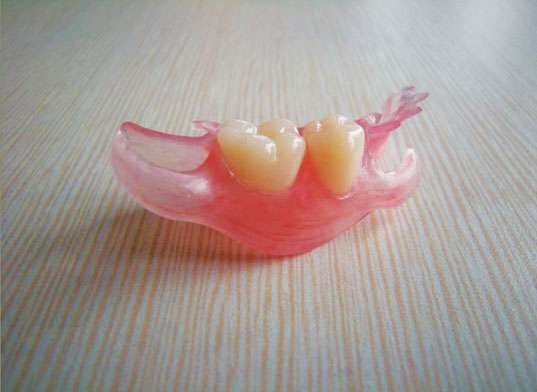
Removable dentures, "removable dentures"
Removable dentures are medically called “removable dentures”. It refers to a kind of prosthesis that uses the remaining real teeth, mucosa, and alveolar bones in the mouth as support, and uses the retainers and bases of the dentures to obtain retention, which is used to repair missing teeth and adjacent soft and hard tissues. It consists of artificial teeth, bases, support brackets, retainers and connectors.
What are the advantages and disadvantages of removable dentures?
1. It is more convenient to keep the dentures clean. If the bacteria on the dentures are not washed off, these bacteria will grow and multiply, excrete bacterial toxins, and cause inflammation of the oral mucosa. In addition, food is easily embedded between dentures and real teeth, causing tooth decay. Removable dentures are easy to wear and remove, and are very easy to clean. They can avoid inflammation and reduce damage to other teeth.
2. Removable dentures cause less damage to real teeth. Fixed dentures require grinding the real teeth on both sides of the missing teeth to be smaller, just like building a bridge. The real teeth are equivalent to the piers on both sides of the bridge, which causes great damage to the real teeth; unlike fixed dentures, removable dentures do not need to be so troublesome, and only need to grind a position for the hook to be placed.
3. Widely used. Whether you are missing a single tooth or multiple teeth, or all your teeth are gone, you can wear a removable denture.
4. Flexible and diverse designs. No matter how many teeth are missing, removable dentures can restore the integrity of the dentition. If the patient’s oral conditions allow, you can also replace them with fixed dentures and implants.
5. Economical and affordable. Removable dentures are cheaper and will not bring a large economic burden.
Precautions for removable dentures
When you first wear removable dentures, you will have a lot of saliva, unclear speech, poor retention, nausea, etc. This is a common phenomenon. After a period of adaptation and doctor’s adjustment, the above phenomena will gradually disappear.
After losing teeth, some elderly people have formed an incorrect occlusion relationship due to long-term wearing of inappropriate dentures or have never had dentures, which affects the retention and chewing function of dentures. Therefore, after wearing dentures, you should practice biting things with your back teeth to correct bad biting habits.
When you first wear removable dentures, if you have slight pain, difficulty wearing and taking off, biting your tongue, biting your cheeks, etc., you should insist on wearing them for a period of time. If eating with dentures is painful, you should go to the hospital for follow-up and make timely adjustments; you should insist on wearing them when you go to the hospital, so that the doctor can check the cause of the pain and make correct adjustments to the removable dentures.
When you first wear removable dentures, wear them empty in your mouth for 3 to 4 days to allow yourself to adapt to the dentures, practice speaking and blowing, and then eat after adapting, gradually transitioning from a small amount of soft food and chewing slowly to normal food. Don’t eat hard things, because the bite force is too strong, which can easily cause damage to the gums; don’t eat sticky food, because it can easily stick to the removable dentures, causing psychological barriers for the elderly who are wearing removable dentures for the first time, thinking that they can never adapt to this denture, and thus lose confidence in the dentures.
Pay attention to protecting oral tissues and cleaning removable dentures. After eating every day, you should take out the removable dentures, rinse them with water and rinse your mouth to avoid affecting the health of the oral mucosa. After taking out the removable dentures before going to bed at night, use a soft-bristled toothbrush to clean the dentures and soak them in cold water to keep the dentures clean.
What are removable dentures?
Removable dentures include removable partial dentures and full dentures. The materials are divided into (resin) trays, cast stainless steel trays, titanium alloy trays, pure titanium trays, precious metal trays, elastic invisible dentures, non-fragmentable (resin) trays and many other varieties. Among them, pure titanium trays are more comfortable to wear, and non-fragmentable (resin) trays are more beautiful.
Removable partial dentures are a kind of removable dentures that use the teeth and mucosa remaining in the mouth as support, and are retained by retainers to repair dentition defects, and patients can take them off and wear them by themselves.
Types of removable partial dentures:
Precision attachments
Use various high-precision buttons or locks and other accessories to fix the dentures, which are more beautiful and stable than clasps. Generally suitable for free ends, the last large tooth is missing. The price is relatively expensive.
Traditional clasp removable partial dentures
There are many varieties, including bent stainless steel wire (resin) trays, cast stainless steel trays, titanium alloy trays, pure titanium trays, precious metal trays, elastic invisible dentures, etc. Among them, precious metal trays are most suitable for the posterior teeth, and elastic invisible dentures are more beautiful for the anterior teeth.
Invisible invisible partial dentures
No metal components, the retainer and base are made of special plastics, which are highly elastic, odorless, more beautiful, do not remove tooth tissue, and are less expensive.
Sleeve crown removable partial dentures
Use the original abutment teeth to make sleeve crowns. More beautiful and easy to clean dentures.
Full dentures are those that do not have any remaining teeth in the mouth, but use atmospheric pressure, adsorption force, and oral and facial muscles, especially the lips, cheeks and tongue muscles, to control the dentures.
Dental Implants
Book Now
Cantonese: (866) 405-9737
Invisible Correction
Why choose Dr. Shi?
- Dr. Shi received professional surgical training at Columbia University, Hackensack Medical Center and New York University.
- He has been doing minimally invasive tooth extraction for many years. Many patients are very satisfied with Dr. Shi’s treatment and also recommend their friends and family for dental treatment.
- Dr. Shi’s method of wisdom tooth extraction is minimally invasive, easy to treat, small wound, and quick recovery.
If you have questions about wisdom teeth, you may call or use our online consultation. We provide free consultation.